














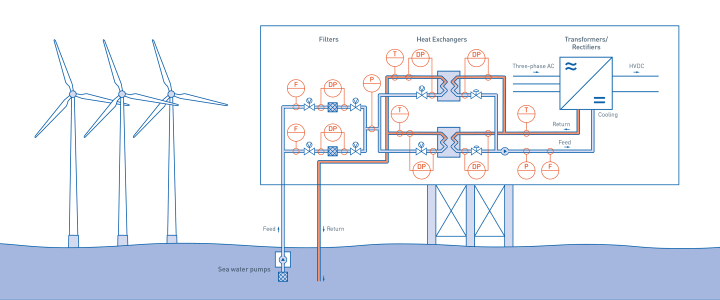
Offshore wind energy – Overview
Offshore wind energy – Sea water feed flow measurement
Offshore wind energy – Differential pressure across inlet strainer
Offshore wind energy – Monitoring of sea water feed pressure
Offshore wind energy – Temperature monitoring of return flow
Offshore wind energy – Differential pressure across heat exchanger primary loop
Offshore wind energy – Differential pressure across heat exchanger secondary loop
Offshore wind energy – Temperature monitoring of return flow
Offshore wind energy – Pressure measurement of the cooling water feed flow
Offshore wind energy – Flow measurement of the cooling water feed
Offshore wind energy – Overview

描述

Sea water feed flow measurement

要求

  • Corrosion resistant
  • Long-term reliable
  • Capable to operate within strong electromagnetic fields, compliant to offshore standards

描述

Sea water feed flow measurement

要求

  • Corrosion resistant
  • Long-term reliable
  • Capable to operate within strong electromagnetic fields, compliant to offshore standards

描述

Differential pressure across inlet strainer

要求

  • Corrosion resistant, shock resistant
  • Long-term reliable
  • Capable to operate within strong electromagnetic fields, compliant to offshore standards

描述

Differential pressure across inlet strainer

要求

  • Corrosion resistant, shock resistant
  • Long-term reliable
  • Capable to operate within strong electromagnetic fields, compliant to offshore standards

描述

Monitoring of sea water feed pressure

要求

  • Corrosion resistant, shock resistant
  • Long-term reliable
  • Capable to operate within strong electromagnetic fields, compliant to offshore standards

描述

Temperature monitoring of return flow

要求

  • Corrosion resistant, vibration resistant
  • Long-term reliable
  • Capable to operate within strong electromagnetic fields, compliant to offshore standards

描述

Temperature monitoring of return flow

要求

  • Corrosion resistant, vibration resistant
  • Long-term reliable
  • Capable to operate within strong electromagnetic fields, compliant to offshore standards

描述

Differential pressure across heat exchanger primary loop

要求

  • Corrosion resistant, shock resistant
  • Long-term reliable
  • Capable to operate within strong electromagnetic fields, compliant to offshore standards

描述

Differential pressure across heat exchanger primary loop

要求

  • Corrosion resistant, shock resistant
  • Long-term reliable
  • Capable to operate within strong electromagnetic fields, compliant to offshore standards

描述

Differential pressure across heat exchanger secondary loop

要求

  • Long-term reliable
  • Capable to operate within strong electromagnetic fields, compliant to offshore standards

描述

Differential pressure across heat exchanger secondary loop

要求

  • Long-term reliable
  • Capable to operate within strong electromagnetic fields, compliant to offshore standards

描述

Temperature monitoring of return flow

要求

  • Vibration resistant
  • Long-term reliable
  • Capable to operate within strong electromagnetic fields, compliant to offshore standards

描述

Pressure measurement of the cooling water feed flow

要求

  • Long-term reliable
  • Capable to operate within strong electromagnetic fields, compliant to offshore standards

描述

Flow measurement of the cooling water feed

要求

  • Long-term reliable
  • Capable to operate within strong electromagnetic fields, compliant to offshore standards

Overview

Offshore wind energy in the sustainable energies industry

Reliable cooling circuit monitoring for uninterrupted wind power generation

Offshore wind farms are large-scale renewable energy installations located at sea, where wind conditions are more stable and powerful than on land. Each wind turbine converts kinetic wind energy into electrical power using a rotor connected to a gearbox and generator. The electricity produced is transmitted via internal cabling to an offshore substation, where it is transformed to a higher voltage and sent through subsea cables to the mainland grid. These farms can consist of dozens or even hundreds of turbines working together as a connected system, requiring precise coordination and continuous monitoring to operate efficiently.

In addition to the turbines themselves, offshore wind farms rely on several supporting systems – including cooling circuits for power electronics, converters and generators. These components generate significant heat during operation, and if not properly cooled, can suffer from performance loss or damage. The cooling systems, often water- or glycol-based, circulate coolant through the components to maintain safe operating temperatures even under fluctuating load conditions.

To ensure these systems function reliably in the harsh offshore environment, robust and accurate process instrumentation is essential. Flow meters monitor coolant circulation and detect deviations in flow rate, temperature sensors ensure thermal stability, pressure transmitters identify blockages or leaks, and level measurement systems safeguard against low coolant levels. Durable and corrosion-resistant instruments are vital in withstanding saltwater, humidity, and strong vibrations. By enabling precise monitoring and control, measurement technology supports the safe, efficient, and uninterrupted operation of offshore wind farms – securing energy output and reducing maintenance interventions.