












Overview
Hydrogenation in SAF production
Catalytic removal of oxygen from renewable feedstocks using hydrogen injection
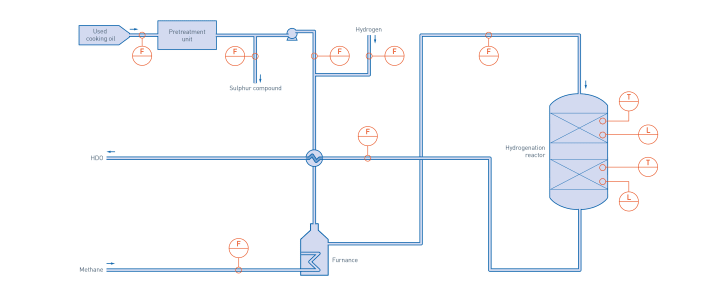
First, the raw feedstock undergoes a pre-treatment phase. During pre-treatment, the feedstock is degummed and bleached to remove impurities that could negatively affect downstream processes, such as free fatty acids and heavy metals. The medium during pre-treatment may contain a high level of impurities and solids, making the selection of appropriate instrumentation critical. To minimise wear and tear, it is recommended to use full-bore flowmeters, such as ultrasonic flowmeters (OPTISONIC 3400) or single straight-tube Coriolis mass flowmeters (OPTIMASS 7400), in order to extend the service life of the instruments. For pressure measurement, ceramic pressure transmitters, such as the OPTIBAR PC 5060, are recommended to withstand the abrasive nature of the medium, as conventional metallic diaphragm transmitters may be more susceptible to damage.
After the pre-treatment stage, a sulphur-containing compound is added to maintain catalyst activity during the hydrogenation reaction. In dosing applications, high accuracy is essential, and a Coriolis mass flowmeter is therefore recommended. Hydrogen is added upstream of the reactor to dilute the feed and is pre-heated using the reactor outlet and a furnace, reaching operating conditions of up to 350 °C and 100 bar inside the reactor. Precise and redundant control of the feed entering the reactor is critical for stable operation. A twin configuration of the OPTISONIC 3400 provides a precise and redundant setup, with optional SIL certification for safety applications.
In the hydrogenation reactor, hydrogen is introduced over a catalyst, which removes oxygen atoms from fatty acids, producing paraffins and water. By-products of the reaction include propane and CO₂. The hydrogenation reaction is highly exothermic, and flow control is of critical importance. A redundant flow measurement setup, such as a TWIN OPTISWIRL 4200 or TWIN OPTISONIC 8300, provides a reliable solution to this challenge. Level measurement within the reactor can be performed using electronic differential pressure. The OPTIBAR eDP PM 5060 is less sensitive to temperature fluctuations, which could negatively influence conventional differential pressure systems using capillaries. Gold-plated diaphragms are available as an option to improve resistance to hydrogen permeation.
Approximately 75% of the hydrogen remains unreacted and is recycled back into the process. At the outlet of the reactor, a two-phase high-temperature fluid may occur due to gas entrainment. The OPTIMASS 6400, with built-in Entrained Gas Management (EGM), is capable of measuring under such conditions and can operate reliably at process temperatures of up to 400 °C.