










Overview
Fractionation in SAF production
Destillation and custody transfer of the final product
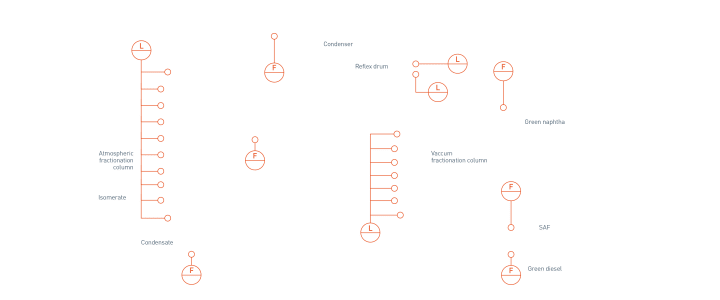
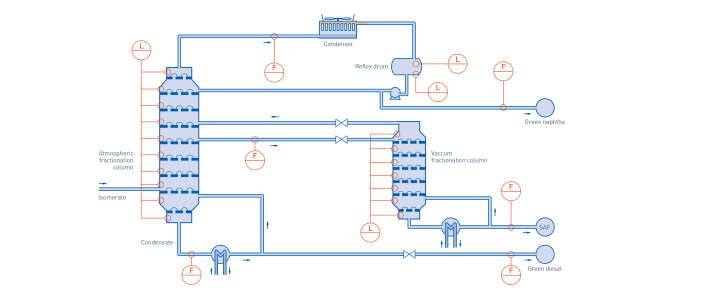
The isomerate is sent to the fractionation column, where it is distilled and separated into the final end products. To monitor the tray level, a guided radar in a bypass chamber is recommended to prevent overfilling of the column. The bottom product is at high temperature and may contain coke particles. For this reason, it is recommended to use a full-bore flowmeter such as the OPTISONIC 4400, which can handle contaminated liquids and high temperatures without creating additional pressure drop. The bottom fraction is sold as green diesel or HVO.
The overhead product leaves the column at a much lower temperature in gaseous form and is subsequently condensed in the reflux drum. Any remaining non-condensable gases are separated, while the condensed liquid is recovered and sold as green naphtha.
The mid-fraction is routed to the vacuum fractionation column to improve separation and remove any remaining impurities that could negatively affect the cloud point. The end product meets SAF specifications and is delivered to the customer. The objective of the fractionation column is to maximise SAF yield while ensuring that fuel specifications are met.
As the final products are sold commercially, custody transfer (CT) measurement is required. SAF represents the largest fraction and therefore the largest line sizes. The OPTIMASS 2400 Coriolis mass flowmeter, with its straight-tube design and compact installation envelope, is well suited for these applications. The meter is MID MI-005 and OIML R117 compliant, making it suitable for custody transfer measurement of liquid hydrocarbons.
Alternatively, the ALTOSONIC 5 may be selected. This custody transfer (CT)-approved ultrasonic flowmeter is particularly suitable for large line diameters. For green diesel and green naphtha, the line sizes are typically smaller. In these cases, the OPTIMASS 6400 Coriolis mass flowmeter is a suitable alternative and is also approved for custody transfer applications.
KROHNE provides complete turnkey metering skids for custody transfer (CT) and fiscal metering applications. These fully integrated measurement systems are mounted on a steel frame, combining flowmeters, process instrumentation, piping, and control equipment into a single pre-assembled unit. Each skid is designed, manufactured, configured, and tested prior to shipment, significantly reducing installation time and commissioning effort on site.