
















Overview
Ship loading in CCS processes
Safe and efficient transfer of liquefied CO₂ to cargo tanks
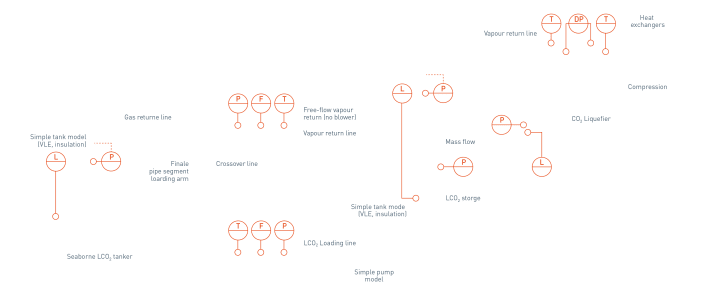
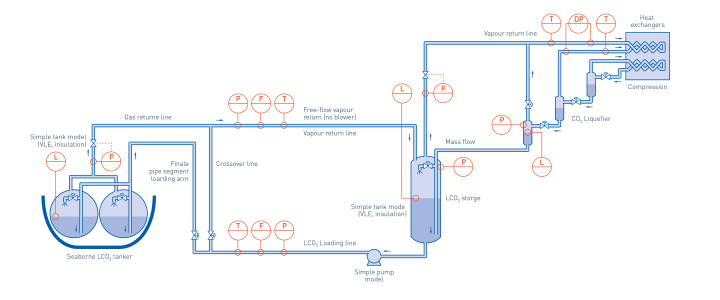
Liquefied CO₂ is transported over long distances by ship, requiring a carefully controlled loading process to maintain safety and efficiency. At the terminal, large insulated storage tanks keep the CO₂ in a liquid state at low temperatures. Transfer lines or loading arms, specially designed for low-temperature and high-pressure operation, connect these tanks to the ship.
High-capacity cryogenic pumps transfer the liquid CO₂ into the vessel’s insulated cargo tanks. Prior to loading, cooling systems pre-chill the lines and tanks to avoid ice formation and thermal stress. As the tanks fill, displaced CO₂ vapours are returned to the terminal via a dedicated gas return line, helping to stabilise pressure and prevent overfilling. These vapours are then recompressed and either returned to storage in liquid form or processed further. Once loading is complete, the transfer lines are purged, and the system is safely disconnected – readying the ship for transport to its final destination.
Precision and reliability are critical when transferring liquefied CO₂ to marine vessels. KROHNE’s instrumentation ensures safe and efficient loading by providing accurate measurement of flow rates, pressures, temperatures, and tank levels throughout the process.
From monitoring cryogenic pump performance and verifying loading quantities to controlling pressure balance via vapour return lines, KROHNE’s robust sensors and systems support stable operation under extreme conditions. With decades of experience in marine and cryogenic applications, KROHNE enables operators to optimise transfer efficiency, minimise losses, and maintain full control over one of the most sensitive stages in the CO₂ transport chain.