















Overview
Pre combustion in CCS processes
Pre-combustion gas treatment for decarbonisation
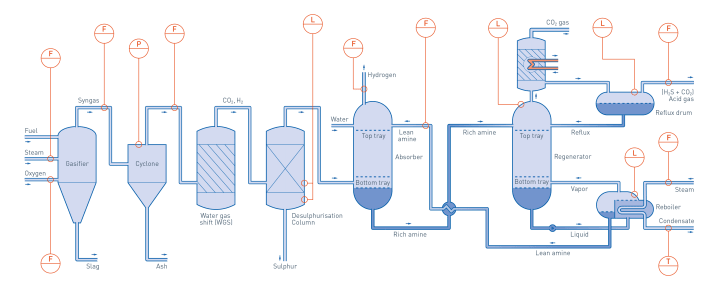
Pre-combustion carbon capture removes CO₂ from fuel before it is burned – a proven method used in power plants and industrial facilities to lower emissions early in the process. The fuel, such as coal, natural gas or biomass, is first partially oxidised in a gasifier, producing synthesis gas (syngas) made up of hydrogen (H₂) and carbon monoxide (CO). This syngas then reacts with steam in a water-gas shift process, converting CO into CO₂ and generating more hydrogen.
The resulting gas mixture, rich in H₂ and CO₂, enters an absorber column filled with an amine-based solvent like monoethanolamine (MEA). The solvent selectively absorbs the CO₂, while the hydrogen – now largely CO₂-free – can be used as a clean energy source.
The CO₂-rich solvent is heated in a regeneration column, releasing high-purity CO₂. This can then be compressed and stored underground, used in industrial applications. The regenerated solvent is cooled and returned to the absorber, enabling a continuous capture cycle. By separating CO₂ before combustion, this process offers an efficient path to cleaner energy and supports efforts to combat climate change.KROHNE’s process instrumentation plays a critical role in the success of pre-combustion CO₂ capture systems. By delivering precise and reliable measurements of flow, pressure, temperature, and level, KROHNE ensures that the complex gas treatment processes run safely and efficiently.
Accurate monitoring enables optimisation of the capture process, minimises operational risks, and helps to reduce overall costs. With KROHNE’s expertise, industries can confidently advance their decarbonisation goals by effectively capturing CO₂ before combustion.