











Overview
Post combustion in CCS processes
Carbon dioxide removal from flue gas streams
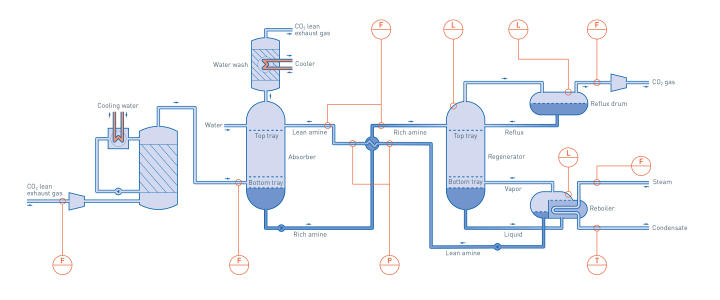
The post-combustion CO₂ capture process is a crucial technology for reducing carbon dioxide emissions from power plants and industrial sources. It begins with cooling the hot flue gas using a flue gas cooler or heat exchanger. The cooled flue gas may undergo pre-treatment to remove impurities such as sulphur oxides (SOx), nitrogen oxides (NOx), and particulate matter that could interfere with the CO₂ capture process.
The pre-treated flue gas is then passed through an absorber column, where it comes into contact with a liquid solvent, often an amine-based solution like monoethanolamine (MEA), which selectively absorbs the CO₂, forming a rich solvent. The CO₂-depleted flue gas, now mostly nitrogen and water vapour, exits the top of the absorber column and is released into the atmosphere. The CO₂-rich solvent is pumped to a stripper or regeneration column, where it is heated, causing the CO₂ to desorb (release) from the solvent. The released CO₂ gas is collected and may undergo further purification to remove any residual impurities, resulting in a high-purity CO₂ stream. The purified CO₂ is then compressed and can be stored underground or utilised in various industrial applications. The lean solvent, now free of CO₂, is cooled and recycled back to the absorber column to capture more CO₂ from the incoming flue gas. This continuous loop allows post-combustion CO₂ capture systems to effectively reduce CO₂ emissions from existing power plants and industrial facilities, contributing to efforts to mitigate climate change.
KROHNE offers a range of measurement technology tailored to the requirements of the post-combustion CO₂ capture process. KROHNE's measurement technology supports the precise monitoring and control of flow, level, pressure, and temperature at various stages of the CO₂ capture process. These technologies help enhance plant efficiency, ensure process safety, and reduce environmental impact. By employing these measurement solutions, operators of CO₂ capture facilities can optimise their processes and actively contribute to combating climate change.