






















Overview
Liquefaction in CCS processes
Controlled liquefaction and storage of pressurised CO₂
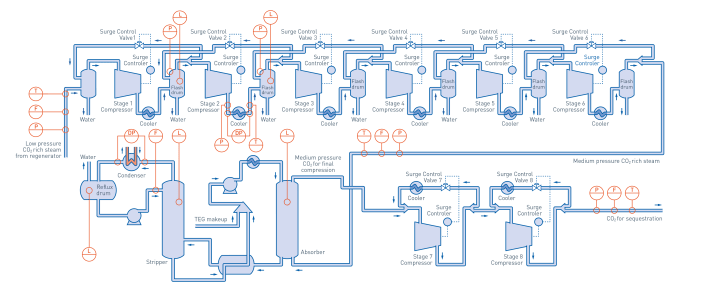
The CO₂ liquefaction process converts gaseous carbon dioxide into liquid form, enabling more efficient transport and long-term storage. Following its capture, the CO₂ gas is gradually compressed in multiple stages to pressures of around 70 bar, initiating the condensation process. It is then cooled using heat exchangers, bringing it close to its critical temperature of 31 °C.
To ensure purity, the gas passes through a Triethylene Glycol (TEG) absorber, which removes moisture and other contaminants. Further compression and cooling steps lead to full liquefaction. The resulting liquid CO₂ is stored in insulated tanks under controlled pressure and temperature conditions, ensuring stability during handling. In its liquid state, CO₂ can be efficiently transported via pipelines, ships, or tankers to storage sites or for industrial use. This process is a key step in the carbon management chain, enabling safe and scalable CO₂ handling and supporting broader decarbonisation strategies.
Precise measurement is essential throughout the CO₂ liquefaction process – from compression and cooling to purification and storage. KROHNE’s high-performance instrumentation ensures accurate monitoring of flow, pressure, temperature, and level across all critical stages. This enables operators to maintain optimal process conditions, maximise energy efficiency, and safeguard equipment integrity. Whether measuring the flow of CO₂ through heat exchangers, monitoring pressure in multi-stage compressors, or controlling tank levels during storage, KROHNE provides robust, reliable solutions tailored to the demands of liquefied gas applications.